
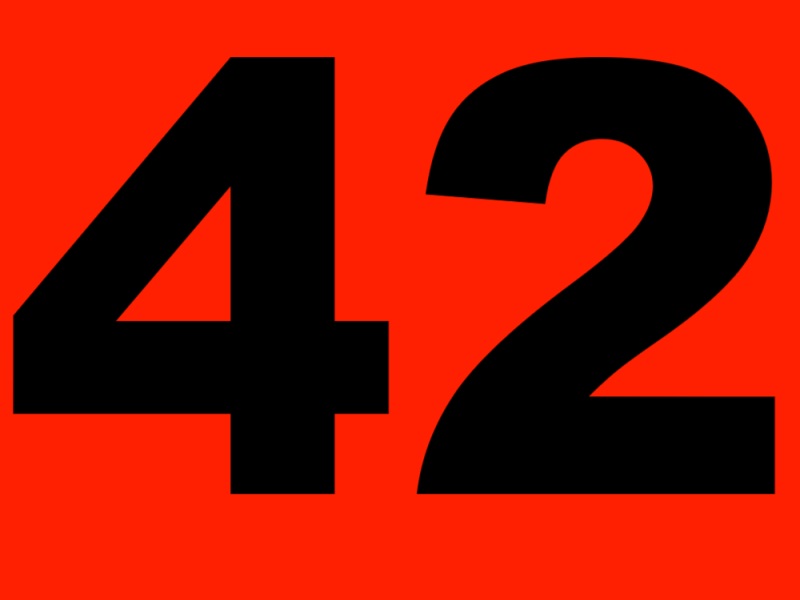
42. Forty-Two
The Number 42
At first glance, 42 is ordinary, modest, even boring. A two-digit number between 41 and 43, made up of a four and a two. But can something so seemingly insignificant really be the most famous answer in the history of science fiction, the holy grail for programmers, mathematicians, and esotericists alike? It can, and for good reason.
Let's start with the most famous one. In the genius mind of Douglas Adams, in his The Hitchhiker's Guide to the Galaxy, 42 is the Ultimate Answer to the Ultimate Question of Life, the Universe, and Everything. A supercomputer named Deep Thought took 7.5 million years to calculate it. The irony? When it was finally announced, no one knew what the actual question was. The answer is there—clear and precise—but completely useless without the right context. It's the perfect allegory for our eternal search for meaning: we often find answers, but they are riddles in themselves. Adams chose it simply because he liked how "forty-two" sounded. Short, crisp, a bit absurd. And it was precisely that absurdity that made the number immortal.
But 42 isn't just a joke. Step into the world of mathematics, and you'll see it's a nerd with pedigree. It's a "pronic" number, meaning it has exactly eight divisors (1, 2, 3, 6, 7, 14, 21, 42). Even more interestingly, 42 is the sum of the first six even numbers (2+4+6+8+10+12). And for Pythagoras fans, it's a "pentagonal" number—you can arrange it into a perfect pentagon. And only in 2019 did mathematicians solve one of the most famous puzzles involving 42: how to express it as the sum of three cubes, i.e., solve the equation x³ + y³ + z³ = 42. It took them 1.3 million hours of computing time to find the solution, making 42 the last number under 100 to be solved in that problem. So, the number was literally the "final hurdle."
If we look at nature, 42 surrounds us. To get the golden ratio, do you divide 1 by 42? No, but the 42-degree angle is perfect for a rainbow—that's the optimal angle at which sunlight enters raindrops to split into a spectrum of colors. In Japanese culture, the number 42 (shini) sounds almost like the word for "death" (shi), so it's often avoided, much like our number 13. In popular culture, 42 is also Jackie Robinson's jersey number—the first African American in MLB—symbolizing courage and breaking down barriers.
The most beautiful thing about 42 is that it is whatever we want it to be. It's a symbol of quest, curiosity, and humor. It teaches us that sometimes an answer isn't the end, but the beginning of a new adventure. As long as 42 exists, so will the question: "But what, for heaven's sake, was the actual question?"
And perhaps that—knowing how to ask the right question—is the only thing we truly need to know. Everything else is, as Adams would say, ... 42.